How Does Real Estate CRM Software Work? Complete 2026 Guide
Real estate CRM software serves as the automated central engine for a brokerage. Rather than just storing phone numbers, it (1) ingests leads from portals (Zillow, Realtor.com, ads) in seconds, (2) syncs live listings via the RESO Web API/MLS, (3) auto-assigns leads to agents via round-robin rules, (4) triggers instant SMS/email drip sequences, and (5) tracks contract-to-close escrow milestones with integrated e-signatures and commission payouts.

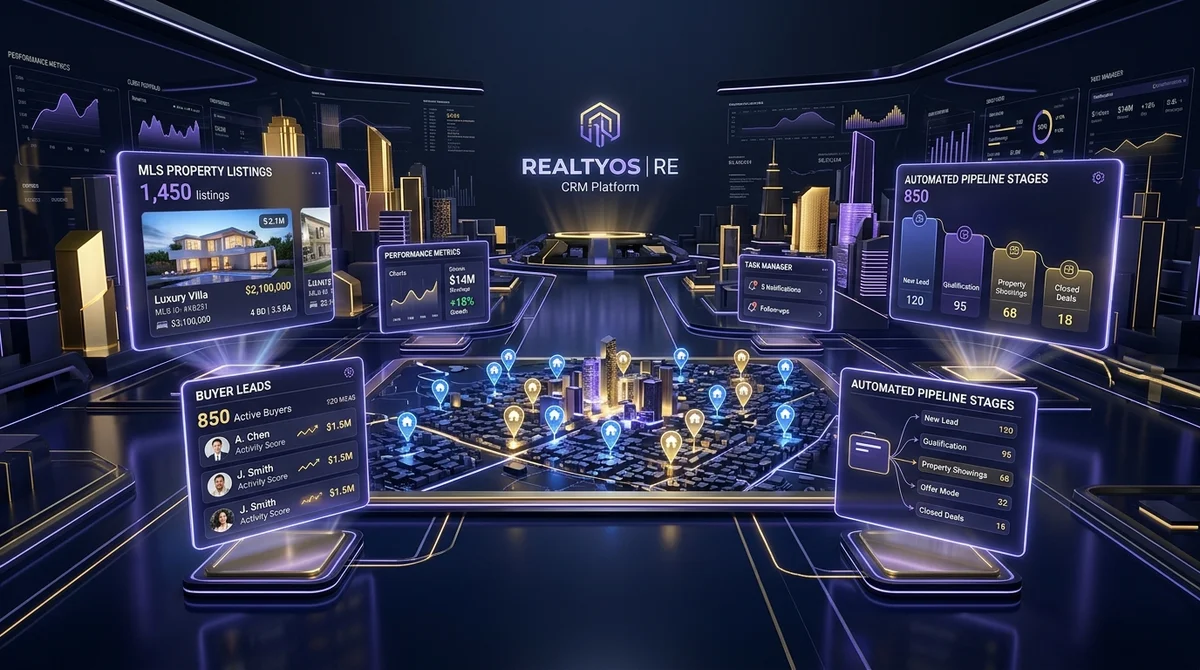
In high-velocity residential and commercial brokerage operations, the modern real estate transaction is no longer managed through paper folders, fragmented spreadsheets, or standard address books. According to the National Association of Realtors (NAR) Technology Survey, Customer Relationship Management (CRM) platforms rank as the single most impactful software asset driving brokerage profitability, cited by over 73% of top-producing firms.
Yet, many brokers and team leaders still view CRMs as mere "digital rolodexes." In technical reality, a high-performing real estate CRM operates as an event-driven distributed operating system. It continually ingests webhooks from advertising portals, normalizes regional Multiple Listing Service (MLS) schemas via RESO Web APIs, scores buyer purchase intent, routes inquiries within seconds to territory agents, and synchronizes legal contingencies all the way through escrow disbursement.
In this comprehensive engineering and operational guide, we dissect exactly how real estate CRM software works under the hood, how its architectural data pipelines function, and why leading brokerages partner with specialized real estate CRM development teams to engineer custom systems that outperform off-the-shelf software.
Landmark research published in the Harvard Business Review demonstrated that sales teams that attempt contact within 5 minutes of an online inquiry are nearly 7 times more likely to qualify the lead than those who wait an hour—and over 21 times more likely than those who wait 24 hours. A real estate CRM's primary engine is engineered to collapse this response window to under 60 seconds.
What is Real Estate CRM Software (And Why Generic CRMs Fail)?
At its core, a Real Estate CRM (Customer Relationship Management) platform is a domain-specific software suite that centralizes, orchestrates, and automates every touchpoint between property seekers (buyers, sellers, tenants, and institutional investors), licensed agents, transaction coordinators, and lending partners.
While horizontal CRM systems like standard HubSpot or Salesforce Essentials function adequately for linear B2B software sales, they systematically collapse under the complexities of real estate. Real estate sales pipelines are defined by two distinct operational realities:
The Anatomy of a Property Deal: Long Cycles and High Stakes
Unlike purchasing consumer goods or business subscriptions, buying or selling property involves the largest financial commitment in an individual's lifetime. The customer journey spans 6 to 18 months of latent consideration, punctuated by high-stress micro-moments: competitive open-house bidding wars, financing approvals, structural inspection surprises, and multi-party escrow contracts. A generic CRM fails because it lacks the data models to link prospective buyers to fluctuating inventory without extensive, costly custom modifications.
Real Estate Data Entities vs. Traditional B2B Objects
To understand how real estate CRM software works, you must first inspect its relational database schema. In standard B2B software, relationships follow a predictable hierarchy: Lead → Contact → Account → Opportunity.
In contrast, an enterprise real estate CRM is architected around specialized relational objects tailored to the physical built environment and regulatory requirements:
- Listing & Parcel Entities: Normalized fields for MLS Number, APN (Assessor's Parcel Number), listing status (Active, Pending, Contingent, Closed), property type (Single Family, Multi-Family, Commercial), HOA fees, and zoning attributes.
- Dual-Role Contact Entities: Contacts frequently toggle roles—a homeowner selling a luxury suburban property is simultaneously a buyer searching for an urban condominium. Real estate CRMs track concurrent dual-pipeline lifecycles for the same contact record.
- Showing & Access Objects: Records tracking scheduled viewings, lockbox access codes, digital feedback surveys, and seller showing permissions.
- Contingency Milestones: Contract-to-close records containing inspection contingency deadlines, mortgage commitment dates, earnest money receipt confirmations, and title clearing statuses.
The Core Engine: 7 Ways Real Estate CRM Software Works Behind the Scenes
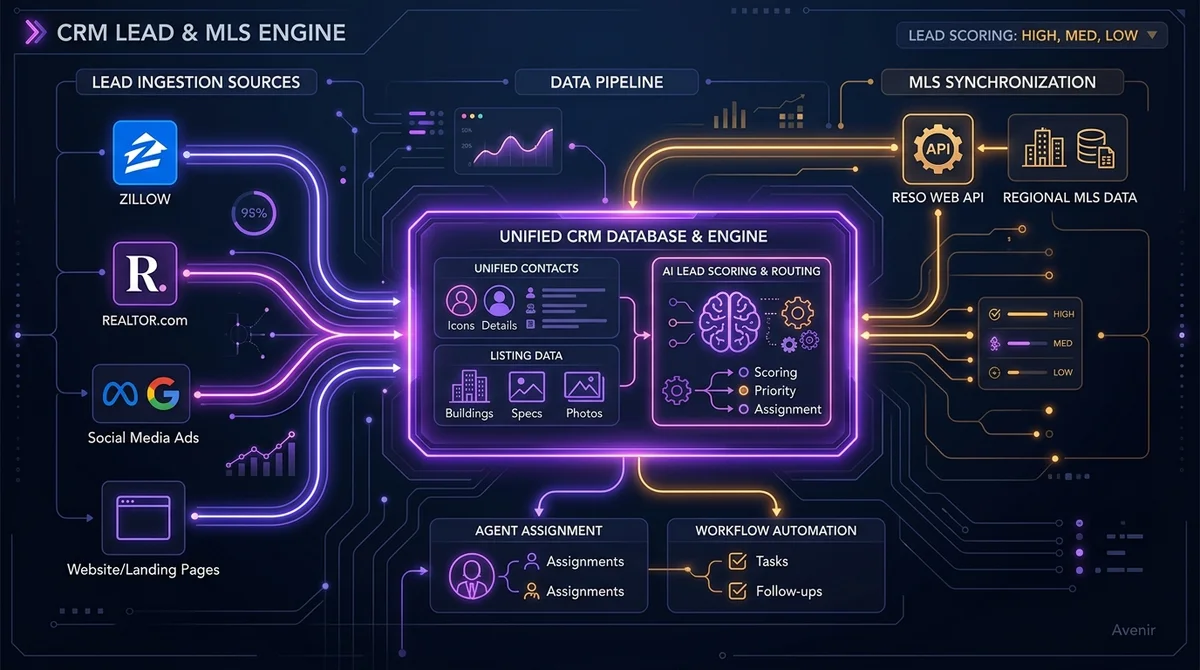
To see how the platform functions in daily practice, let us examine the seven discrete subsystems that constitute a modern real estate CRM engine:
1. Omnichannel Ingestion & Real-Time Lead Parsing
Real estate inquiries originate from a chaotic variety of marketing channels: third-party syndication portals (Zillow, Trulia, Realtor.com), social media ad campaigns (Meta Lead Ads, Google Local Services Ads), brokerage websites (IDX home-search widgets), and yard-sign QR codes.
When a prospective homebuyer clicks "Request More Info" on a listing, the CRM captures the lead in one of three ways:
- Direct RESTful Webhooks: Modern advertising platforms push a real-time JSON payload directly into the CRM's ingestion endpoint containing name, phone number, email, and the originating listing MLS number.
- Standardized Email Parsing (ADF/XML): For platforms lacking webhooks, the CRM monitors dedicated inbox gateways. Its parsing engine strips incoming Auto-lead Data Format (ADF) or XML emails to extract contact parameters and property preferences within 2 to 3 seconds.
- Browser Session & Pixel Tracking: Brokerage websites embedded with the CRM's tracking pixel record every property viewed, price filters applied, favorite listings saved, and mortgage calculators computed.
2. Automated Lead Distribution & Territory Round-Robin Rules
Once a lead is ingested, the CRM evaluates it against the brokerage's operational routing rules. Top brokerages avoid manual assignment bottlenecks by configuring programmatic routing algorithms:
- Geographic & Zip-Code Routing: Inquiries are instantly routed to agents licensed and specialized in specific neighborhoods or municipal school districts.
- Price-Tier Segmentation: Inquiries over $1,500,000 route exclusively to the firm's luxury division, while first-time buyer inquiries route to junior associates.
- Round-Robin with SLA Escalation: Leads cycle evenly through team members. If the assigned agent fails to open the notification or initiate contact within 4 minutes, the CRM automatically re-assigns the prospect to the next available agent on duty.
3. MLS Synchronization & RESO Web API Data Pipeline
The defining technical superpower of a dedicated real estate CRM is its integration with regional Multiple Listing Services. Built using the modern RESO (Real Estate Standards Organization) Web API, the CRM queries regional listing databases via an Open Data Protocol (OData) interface.
This bi-directional sync powers dynamic property matching:
- Automated Listing Alerts: When a home matching a buyer's saved parameters (e.g., 4 bedrooms in Austin under $750k) changes status to "Active" on the MLS, the CRM instantly drafts a branded notification to the client.
- Price Drop Triggers: If a listing the buyer previously viewed drops in price by 5%, the CRM alerts both the buyer and their assigned agent to prompt an immediate showing offer.
- Reverse Prospecting: When a listing agent enters an exclusive seller agreement, the CRM cross-references the property specs against the brokerage's internal database of active buyer searches, identifying qualified prospects before the home even hits the open market. Explore our dedicated Apex Listings real estate MLS case study to see this in production.
4. Automated Multi-Touch Drip Sequences & Contextual Follow-Up
Real estate agents spend hours on the road touring properties. Without automation, cold leads go stale. The CRM executes contextual, multi-channel communication workflows through SMS, email, automated voicemails, and WhatsApp:
- Instant Two-Way SMS: Within 45 seconds of an online form submission, the CRM sends a personalized text message: "Hi Sarah, thanks for checking out 442 Maple Ave! Are you looking to schedule an in-person tour this weekend, or would you like me to send the seller disclosures?"
- Long-Term Nurture Tracks: For prospects browsing 12 months out from purchase, the CRM schedules educational email drips: local neighborhood market trend reports, interest rate analysis, and step-by-step pre-approval guides.
- AI Conversational Qualifiers: Generative AI conversational agents engage in initial SMS banter, verifying whether the prospect has a pre-approval letter and if they have an active representation agreement with another agent.
5. Visual Pipeline & Escrow Stage Management (Contract-to-Close)
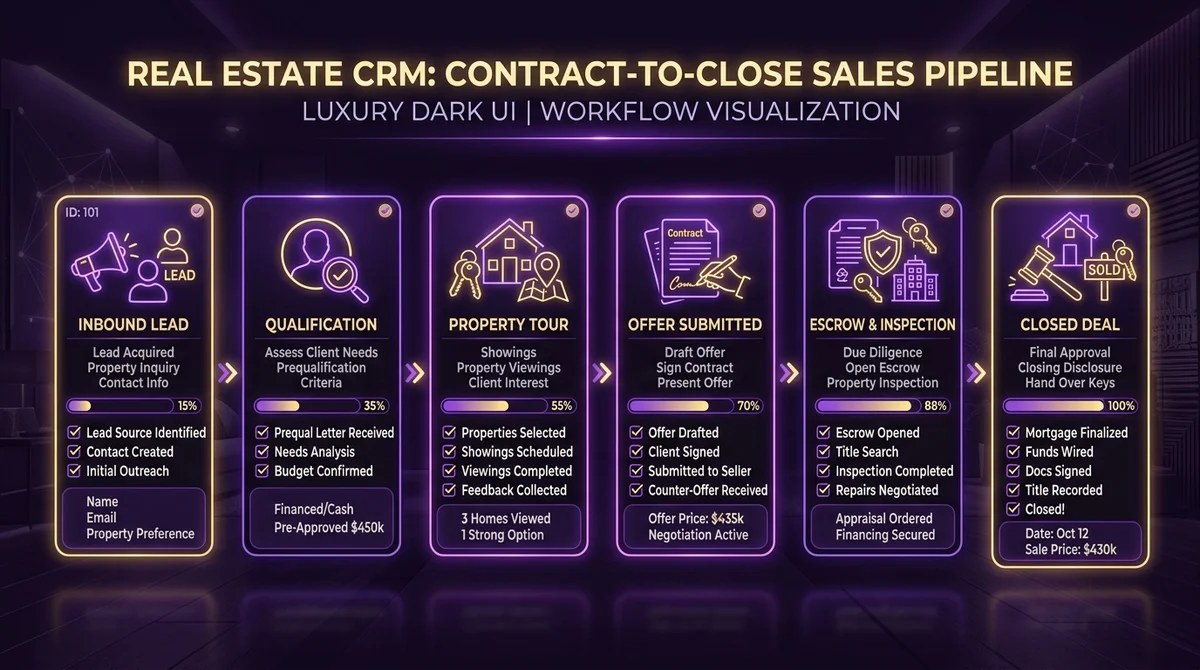
Once a buyer submits a binding purchase offer or a homeowner signs an exclusive listing agreement, the CRM transitions the contact into the Transaction Management & Escrow Pipeline.
Managing a real estate deal from contract to close requires rigorous compliance. The CRM organizes this via visual Kanban stages:
- Stage 1: Mutual Acceptance & Earnest Money Deposit: Triggers calendar deadlines for escrow deposit verification.
- Stage 2: Title & Survey Examination: Automatically notifies the title officer and uploads the preliminary title commitment.
- Stage 3: Property Inspection & Due Diligence: Schedules structural, radon, and pest inspectors; tracks repair request negotiations.
- Stage 4: Appraisal & Underwriting: Logs appraisal valuation; syncs with the mortgage loan officer.
- Stage 5: Final Walkthrough & Closing Disclosure (CD): Generates client checklists and coordinates settlement signing.
6. Document Automation, Compliance & E-Signature Tracking
Property transactions generate dozens of legal disclosures, lead-paint notices, agency acknowledgments, and purchase addenda. Real estate CRMs integrate natively with e-signature engines such as DocuSign and Dotloop.
Agents can generate pre-populated state association purchase contracts using data already stored in the CRM contact and MLS listing records. When documents are signed, the CRM archives cryptographically timestamped audit trails to safeguard broker compliance with state real estate licensing commissions.
7. Agent Field Operations & Mobile Telephony Sync
Real estate agents rarely sit behind desks. A CRM must function as a comprehensive mobile command center. Through native mobile CRM applications, agents in the field benefit from:
- In-App VoIP & Virtual Numbers: Agents place calls and send texts using brokerage-owned numbers. Every phone call is logged, call duration is tracked, and audio recordings or AI call summaries are attached to the client timeline.
- Geofenced Property Check-Ins: When an agent arrives at a scheduled listing tour, GPS geofencing surfaces property gate codes, seller showing instructions, and historical MLS disclosures directly on their smartphone lock screen.
- Open House Kiosk Mode: Tablets running the CRM at open house registration tables capture visitor contact info and automatically fire welcome emails before the prospect even leaves the driveway.
Step-by-Step Data Flow: From Cold Click to Closed Commission
To synthesize how these subsystems interact seamlessly, consider the complete lifecycle of a single real estate transaction within an enterprise CRM system:
| Lifecycle Stage | CRM Data Operation | System Trigger & Output | Key Stakeholder |
|---|---|---|---|
| 1. Ingestion | Webhook parses Zillow portal inquiry payload into unified database. | Instant contact record creation; deduplication against existing phone/email. | Lead Gen Platform → CRM |
| 2. Routing | Evaluates lead price point ($850k) and geographic zip code (90210). | Round-robin assignment with 3-minute SLA push notification. | CRM Lead Router → Agent |
| 3. Engagement | Executes instantaneous two-way SMS and conversational drip nurture. | Prospect replies via text; agent takes over conversation on mobile app. | Client ↔ Agent |
| 4. Inventory Match | RESO Web API queries MLS for active 3-bed homes in desired neighborhood. | Automated branded listing gallery delivered to buyer's phone. | MLS → Client |
| 5. Tour & Offer | Showing schedule logged; purchase offer pre-populated from MLS data. | DocuSign e-signature envelope dispatched to buyer and seller. | Agent ↔ Buyer ↔ Seller |
| 6. Escrow Tracking | Contract-to-close milestone pipeline initiated with deadline triggers. | Inspection, appraisal, title, and loan milestones checked off collaboratively. | Transaction Coordinator |
| 7. Commission Split | Disbursement calculation applied based on agent split tier and desk fees. | Financial records pushed to QuickBooks/ERP; automated review request sent to buyer. | Brokerage Accountant |
Key Technical Integrations That Power Real Estate CRMs
No real estate CRM exists in an island. Its utility is amplified by its ability to integrate with third-party data providers, compliance platforms, and communication nodes. Discover the 5 essential APIs every CRM must integrate with for a broader look at modern system architecture.
RESO Web API, RETS & IDX Property Feeds
Historically, real estate software relied on the Real Estate Transaction Standard (RETS), an XML-based system notoriously plagued by non-standardized field names and high server polling overhead. Modern real estate CRMs leverage the RESO Web API, which employs JSON-based REST architecture and standardizes property nomenclature through the RESO Data Dictionary. This enables real-time synchronization with multiple MLS boards simultaneously without data corruption.
VoIP, Two-Way SMS & WhatsApp Business API
Through integration with telephony backbones like Twilio or Vonage, the CRM routes all voice calls and text messages through virtual brokerage numbers. This protects agent privacy, prevents agents from taking proprietary client phone numbers if they switch brokerages, and ensures full TCPA (Telephone Consumer Protection Act) compliance through automated opt-out tracking.
Transaction Management & E-Signature (DocuSign, Dotloop)
Through deep bi-directional CRM integration services, transaction coordination software ensures that when a contract closes or an inspection addendum is ratified in DocuSign, the corresponding deal milestone in the CRM updates automatically, alerting all parties and triggering commission processing.
Financial, Trust Accounting & Commission Splitting
Real estate brokerages operate on intricate commission splits: tiered production hurdles, franchise royalties, desk fees, transaction coordinator bonuses, and lead-generation splits. Connecting the CRM directly to brokerage accounting tools (such as QuickBooks, Lonewolf, or Xero) automates net agent payouts and tracks total brokerage gross commission income (GCI).
The Business Impact: Proven ROI and Productivity Benchmarks
Implementing an enterprise real estate CRM is not merely an operational convenience—it is a financial multiplier. Independent economic studies from Nucleus Research demonstrate that properly architected CRM software returns an average of $8.71 for every $1 invested.
For a high-volume real estate brokerage, the concrete productivity and financial returns manifest in three core areas:
- Zero Lead Leakage: Industry data reveals that without a centralized CRM, over 48% of real estate inquiries never receive a single follow-up call. Automated routing guarantees 100% lead accountability.
- 35% Reduction in Transaction Administrative Time: Automating contract milestones, document signing reminders, and open house check-ins saves agents an average of 8 hours per week, allowing them to focus on high-value client negotiations.
- Substantial Increase in Referral & Repeat Business: NAR statistics reveal that 89% of buyers state they would use their agent again, yet only 12% actually do—primarily because the agent failed to stay in contact. Real estate CRMs automate long-term anniversary cards, home equity checkups, and local market reports to capture lifelong client equity. Read our comprehensive guide on why having a CRM is important to a business for deeper retention economics.
Custom Real Estate CRM vs. Commercial Off-The-Shelf SaaS
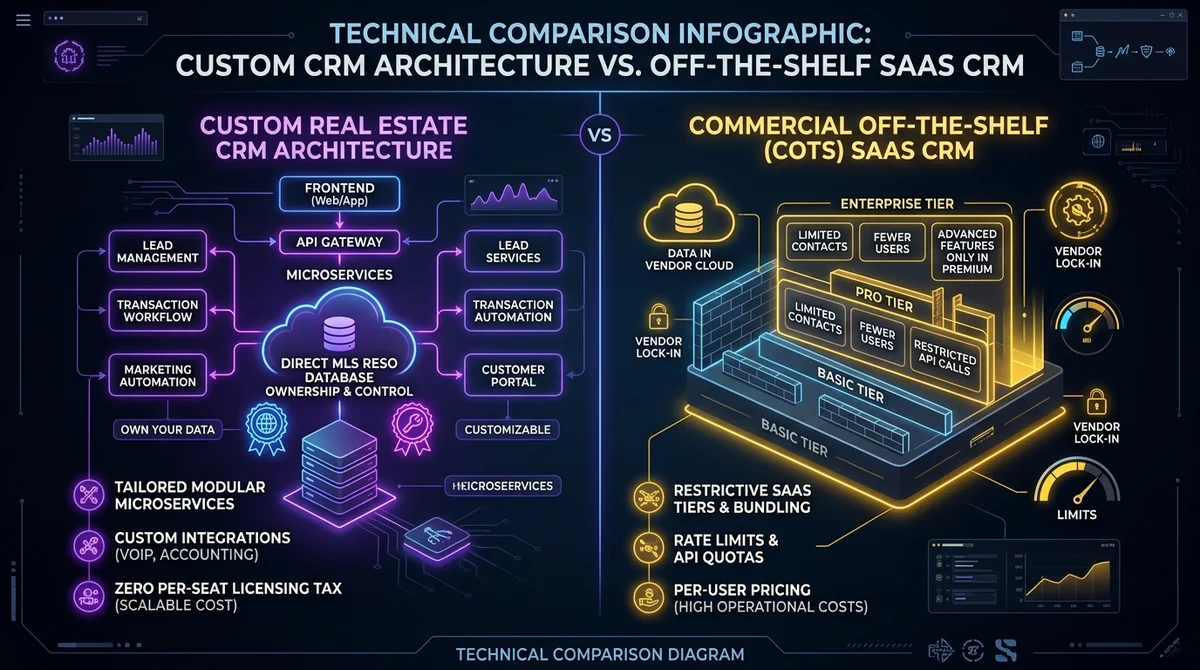
As brokerages scale beyond 25 to 50 active agents, leadership faces a pivotal strategic choice: continue paying recurring monthly subscription fees to commercial SaaS providers (such as kvCORE, BoomTown, or Follow Up Boss) or invest in a custom proprietary real estate CRM architecture.
The table below highlights the critical trade-offs between both architectural models:
| Evaluation Criteria | Commercial Off-The-Shelf (COTS) SaaS | Custom Real Estate CRM Development |
|---|---|---|
| Cost Model & Scalability | High per-seat monthly tax ($75–$250/agent/mo). Costs surge as you hire more agents. | One-time capital development; zero per-seat licensing fees regardless of team size. |
| MLS Integration Agility | Limited to pre-packaged vendor connectors; sluggish adoption of regional MLS quirks. | Direct RESO Web API connectors tailored to your exact regional MLS boards and custom fields. |
| Data Sovereignty & Privacy | Brokerage client data resides on vendor multi-tenant servers, risking vendor lock-in. | 100% proprietary database ownership on your private AWS/GCP/Azure tenant cloud. |
| Custom Workflow Flexibility | Rigid pipeline stages; limited ability to modify internal commission matrices. | Infinite flexibility to code proprietary commission splits, partner portals, and custom mobile tools. |
| M&A Exit Valuation | Zero intellectual property equity; client database lives in third-party software. | Proprietary technology stack significantly increases brokerage EBITDA valuation multiples. |
To explore how custom software engineering eliminates the recurring SaaS tax while granting full database sovereignty, consult our CRM strategy and consulting practice, explore platform implementation services, or review our CRM customization services.
Frequently Asked Questions About Real Estate CRM Software
Explore answers to the most common architectural, operational, and financial questions regarding real estate CRM software implementation:
How does real estate CRM software differ from standard sales CRM software?
How does a real estate CRM capture leads from Zillow, Realtor.com, and Facebook Ads?
What is the role of the RESO Web API in real estate CRM software?
How does automated lead routing work for multi-agent real estate brokerages?
Can real estate CRM software track contract-to-close escrow stages?
Why is the speed-to-lead factor critical in real estate CRM automation?
When should a real estate brokerage build a custom CRM instead of buying commercial SaaS?
Rehan Saeed
Lead ArchitectRehan Saeed is an enterprise CRM architect and founder of CRM Development Services. With over a decade of hands-on engineering experience in distributed database design, RESO MLS data synchronization, and multi-tenant customer relationship systems, Rehan leads custom software initiatives for top-tier real estate brokerages and commercial property enterprises.
Ready to Build a High-Performance Real Estate CRM?
Stop losing deals to slow lead response times and eliminate monthly per-seat SaaS subscription taxes. Let our senior CRM architects design a proprietary real estate platform tailored to your brokerage.