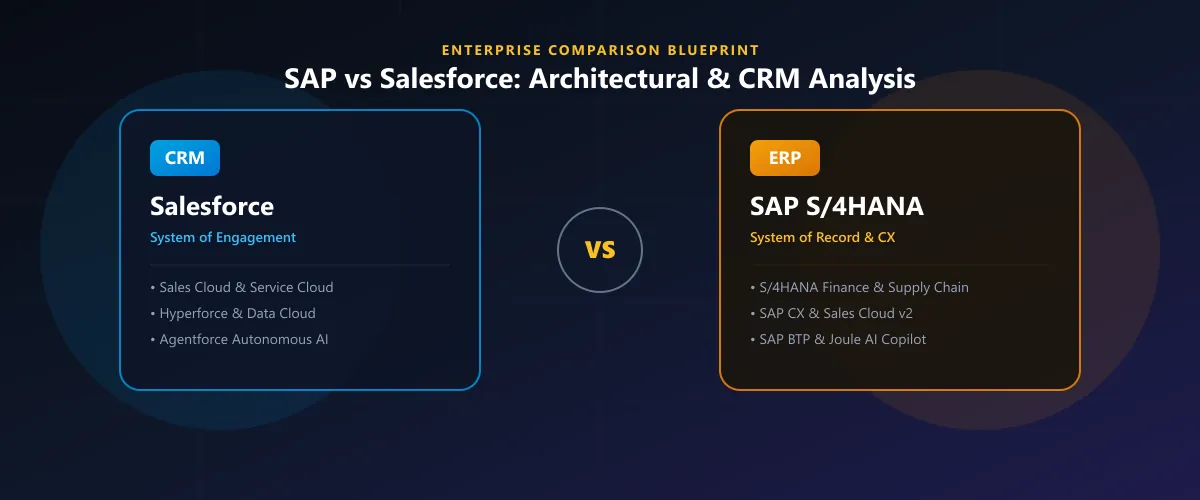
In enterprise boardrooms, the SAP vs Salesforce debate often creates an internal battle between financial and commercial leaders:
- The CFO's Argument (The Single-Vendor Mandate): "We are already investing millions into our SAP S/4HANA digital core. Why pay Salesforce another $300 per user each month when SAP offers its own Customer Experience (SAP CX) suite?"
- The CRO's Reality (User Adoption & Sales Velocity): "If you force our sales reps onto SAP transactional screens, CRM adoption will plummet. We will lose pipeline visibility, deal cycles will lengthen, and our revenue engine will stall."
- The Architectural Reality: Over 78% of Global 2000 enterprises resolve this debate by deploying both platforms in a dual-stack model. Salesforce manages the fast-moving customer journey, while SAP executes back-office fulfillment and financial ledgers.
Table of Contents
1. The Core Enterprise Dichotomy: System of Engagement vs. System of Record
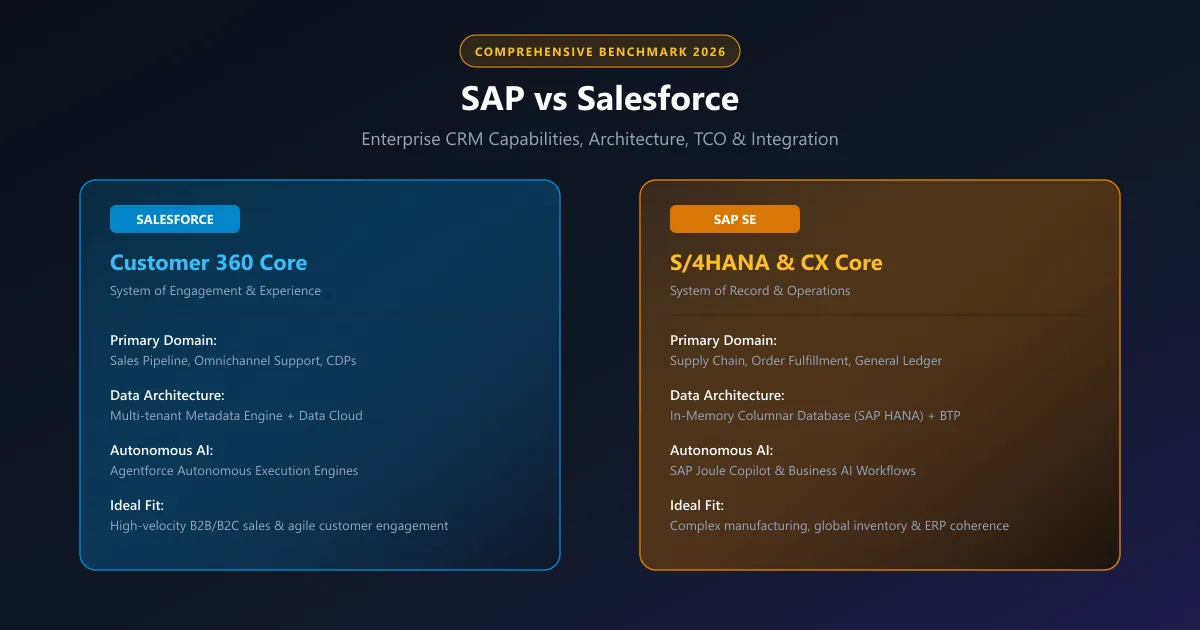
For more than two decades, enterprise technology evaluations have framed SAP vs Salesforce as an ideological conflict between two software monoliths. However, contemporary enterprise architecture reveals that these platforms operate on fundamentally distinct technological philosophies, engineered to solve opposite ends of the corporate value chain.
Salesforce, Inc. was founded in 1999 as a cloud-native platform explicitly designed to empower customer-facing teams. It serves as the enterprise System of Engagement. Salesforce is optimized for fluid, rapid, and polymorphic customer interactions where deal stages evolve hourly, marketing touchpoints fire in real time, and contact records constantly ingest unstructured data streams.
Conversely, SAP SE (founded in 1972) originated as the operational foundation for manufacturing, enterprise logistics, and material accounting. Its flagship ERP suite, SAP S/4HANA, functions as the ultimate System of Record. SAP is engineered for deterministic, ACID-compliant (Atomicity, Consistency, Isolation, Durability) transactional integrity where inventory cannot be double-counted, general ledgers must balance to the exact cent, and compliance standards demand strict historical auditability.
From an architectural standpoint, Salesforce Sales Cloud orchestrates front-office revenue opportunities, customer interactions, and pipeline acceleration, whereas SAP S/4HANA executes back-office asset accounting, inventory deduction, and global supply chain fulfillment.
Industry research from the IDC Worldwide Semiannual Software Tracker consistently positions Salesforce as the market share leader in Customer Relationship Management (CRM) applications, while SAP maintains unmatched market dominance in enterprise resource management, supply chain execution, and digital core operations. Understanding this division is essential before evaluating features or writing integration specifications.
2. Database Architecture & Data Modeling: Salesforce Metadata vs. SAP In-Memory Tables
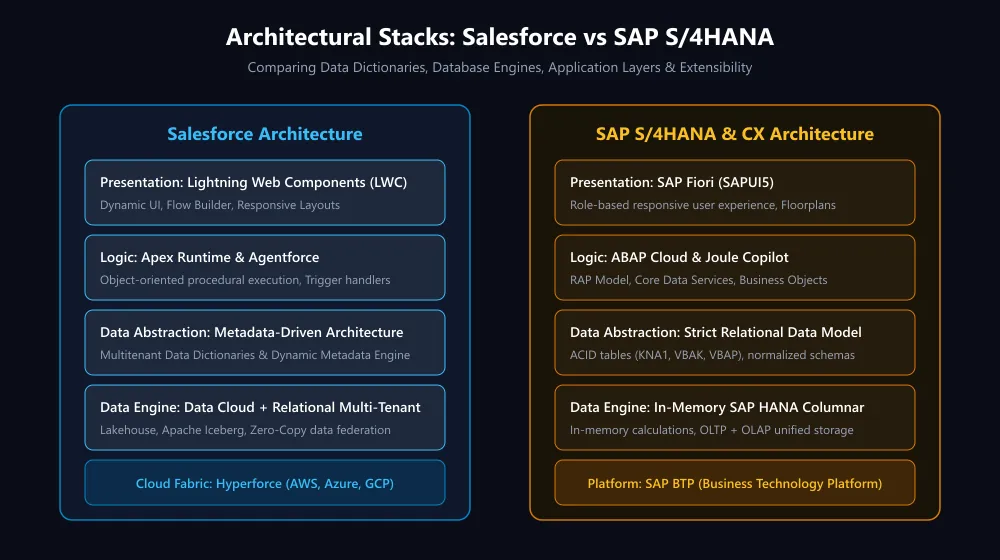
To understand why Salesforce allows non-technical administrators to spin up custom fields within seconds while SAP requires rigorous ABAP Data Dictionary (SE11) governance, one must inspect the underlying database architectures. The core distinction between Salesforce and SAP is rooted in their data storage paradigms.
The Salesforce Multitenant Metadata Runtime Engine
Salesforce operates on a proprietary, multi-tenant relational architecture powered by a metadata runtime engine. Rather than altering physical database schemas whenever an administrator adds a field to an account or contact record, Salesforce uses a virtualized metadata layer:
- Dynamic Business Objects: Standard CRM records (such as accounts, leads, opportunities, and cases) and custom objects are abstracted as virtual structures linked to universal identifiers.
- Universal Data Dictionaries: Custom field definitions are stored as metadata rows in shared dictionary tables, ensuring that database structures remain decoupled from underlying physical storage.
- Flex Data Partitioning: Values reside in pre-allocated flex columns across shared clustered storage, indexed via search engines and compiled on the fly using dynamic SOQL (Salesforce Object Query Language) parsers.
This abstraction permits rapid schema evolution and zero-downtime seasonal platform upgrades. However, it requires developers to design within strict Governor Limits governing heap size, CPU execution time (10,000ms synchronous), and query complexity.
The SAP S/4HANA In-Memory Columnar Database (SAP HANA)
In contrast, SAP S/4HANA relies on physical, highly optimized in-memory columnar database tables managed by SAP HANA. In this paradigm:
- Customer Master Data: Primary account structures reside in physical relational tables like
KNA1(General Customer Master) andKNVV(Sales Area Data). - Sales Documents: Every transaction generates discrete, immutable records across
VBAK(Sales Document Header) andVBAP(Sales Document Item). - Material Master & Inventory: Product definitions live in
MARA, linked to plant-level stock inMARD.
SAP's columnar layout enables massive data compression and sub-second analytical aggregations across hundreds of millions of ledger rows without aggregate tables. However, modifying this schema requires strict architectural governance through the ABAP RESTful Application Programming Model (RAP) or Core Data Services (CDS) views.
| Architectural Dimension | Technical Focus | Salesforce Architecture | SAP S/4HANA Architecture |
|---|---|---|---|
| Data Schema Engine | Storage Abstraction | Metadata-Driven Virtualization (Dynamic Cloud Dictionary) | In-Memory Columnar Relational (SAP HANA Engine) |
| Customer Master Record | Core Table Identifier | Account / Contact (Polymorphic ID prefix 001 / 003) |
KNA1 (General Data) & KNVV (Sales Organization) |
| Sales Transaction | Order Object Storage | Opportunity & Order (Declarative CRM Objects) |
VBAK (Order Header) & VBAP (Order Line Items) |
| Schema Extensibility | Modification Mechanism | Declarative Custom Fields & AppExchange Packages | ABAP Core Data Services (CDS) Views & Extension Ledgers |
| Query Language | Data Retrieval Protocol | SOQL (Salesforce Object Query Language) & GraphQL | OpenSQL, ABAP CDS Views, and native SAP HANA SQL |
| Concurrency & Locking | Lock Management | Optimistic Record Locking with Governor Limits | Pessimistic Enqueue/Dequeue Server Locks (ACID Strict) |
3. Feature Matrix: Salesforce Sales Cloud vs. SAP Customer Experience (SAP CX)
When enterprises compare the native customer-facing toolsets of both vendors, they typically pit Salesforce Sales Cloud and Service Cloud against SAP Customer Experience (SAP CX), which includes SAP Sales Cloud Version 2 and SAP Service Cloud Version 2 built on the SAP Business Technology Platform (SAP BTP).
According to the Gartner Magic Quadrant for Sales Force Automation Platforms, Salesforce has maintained an unbroken leadership trajectory for over a decade, driven by ecosystem breadth, intuitive user experience, and continuous innovation in AI workflow automation.
Where Salesforce Excels:
- Pipeline Velocity & Usability: Sales reps can navigate kanban deal boards, generate automated follow-up cadences, and update opportunities with minimal administrative friction.
- AppExchange Ecosystem: With over 7,000 pre-built enterprise connectors (e.g., DocuSign, Outreach, Gong, ZoomInfo), organizations can assemble best-of-breed sales stacks within days.
- Omnichannel Customer Service: Salesforce Service Cloud sets the benchmark for agent consoles, unified telephony routing, skill-based assignment, and field service dispatch.
- Custom Application Development: If off-the-shelf features do not match unique business logic, professional CRM customization services can extend Salesforce with bespoke Apex triggers and Lightning Web Components.
Where SAP CX / Sales Cloud Excels:
- Direct ERP Configuration & CPQ: For companies manufacturing configurable industrial machinery, SAP CPQ (Configure, Price, Quote) references live bills of materials (BOM), plant manufacturing capacities, and real-time inventory allocation directly from the ERP core.
- Unified Pricing Condition Rules: SAP leverages the classic SD Pricing Condition technique (Condition Tables, Access Sequences, Condition Types). A discount applied in SAP Sales Cloud aligns 1:1 with invoice creation in Finance (FICO) without translation middleware.
- Single-Vendor Governance: For organizations with a strict "Clean Core" SAP mandate, deploying SAP CX on SAP BTP minimizes vendor sprawl and simplifies enterprise procurement.
| Capability | Salesforce (Sales & Service Cloud) | SAP Customer Experience (SAP CX v2) |
|---|---|---|
| User Experience & UI | Lightning Design System (LDS); highly customizable, consumer-grade responsiveness. | SAP Fiori (SAPUI5); role-based, standardized enterprise floorplans. |
| Complex CPQ & BOM | Robust for SaaS & standard goods; requires Revenue Cloud or Logik.io for multi-level BOMs. | Native integration with SAP ERP variant configuration and live production routing. |
| Partner & Developer Network | Over 2.5 million Trailblazers, vast global pool of certified architects and developers. | Extensive enterprise SAP consultancy network; fewer specialized pure-play CRM developers. |
| Customer Data Platform (CDP) | Salesforce Data Cloud; sub-second streaming ingestion with Apache Iceberg federation. | SAP Customer Data Platform; strong identity management (Gigya) and privacy compliance. |
| Offline Field Mobility | Salesforce Field Service app with offline sync and briefcase priming. | SAP Service Cloud mobile client with native ERP equipment master synchronization. |
4. The Quote-to-Cash (QTC) Chasm: Where Most Enterprise Deployments Falter
One of the most frequent operational breakdowns in modern enterprise technology occurs at the boundary between sales execution and order fulfillment. When Salesforce functions as the CRM and SAP operates as the ERP, the Quote-to-Cash (QTC) handoff often becomes a source of revenue leakage and customer friction.
Consider the typical journey of an enterprise deal:
- A sales rep configures an opportunity and produces a signed quote in Salesforce CPQ.
- The opportunity moves to Closed-Won, and an order record is generated.
- The order must now be translated into an official Sales Order inside SAP S/4HANA (tables
VBAKandVBAP) to trigger warehouse fulfillment, credit checks, and manufacturing.
Without deep bi-directional synchronization, three major failures occur:
- Ghost Inventory Commitments: A sales rep closes a multi-million-dollar deal promising shipment within 14 days, unaware that SAP's Material Requirements Planning (MRP) engine has flagged a 6-week supply chain delay on key components.
- Pricing Condition Mismatches: Complex customer discounts, multi-currency conversion rules, or tiered tax codes calculated in Salesforce fail to match SAP's stringent SD pricing logic, throwing the order into billing block status.
- Credit Limit Violations: The customer has exceeded their accounts receivable credit limit in SAP FICO, but because Salesforce lacks real-time ledger visibility, the sales team continues booking new orders that cannot be released to fulfillment.
Bridging this chasm requires an event-driven integration layer that surfaces SAP inventory availability (ATP - Available to Promise) and credit balances directly within the Salesforce Lightning interface.
5. The AI Frontier: Salesforce Agentforce vs. SAP Joule
Artificial intelligence in enterprise platforms has progressed beyond simple predictive lead scoring into the era of Autonomous Agentic AI. Enterprise leaders must evaluate how each vendor implements autonomous reasoning across corporate data lakes.
Salesforce Agentforce: Autonomous Front-Office Action Engines
Launched to transform the standard CRM interface into an autonomous workforce, Salesforce Agentforce utilizes the Atlas Reasoning Engine. Rather than simply generating text summaries for sales reps, Agentforce agents can:
- Autonomously negotiate inbound meeting times, inspect calendar availability, and adjust deal stages.
- Diagnose complex customer service issues across knowledge bases and trigger automated refunds within preset financial thresholds.
- Ground every decision in real-time customer data using Data Cloud zero-copy architecture (connecting Snowflake, Google BigQuery, and Databricks without data duplication).
SAP Joule: Contextual Copilot for Enterprise Process Execution
SAP Joule approaches generative AI from a business process lens. Rather than focusing purely on marketing content and conversation cadences, Joule is embedded across SAP's digital core:
- Supply Chain & Procurement Simulation: Joule analyzes delayed shipments in SAP Transportation Management and suggests alternative suppliers from SAP Ariba based on historical contract margins.
- Financial Reconciliation: Assists controllers in identifying journal entry discrepancies and simulating currency fluctuations across multinational ledgers.
- ABAP Cloud Code Generation: Accelerates developer productivity by generating clean-core compliant ABAP code on SAP BTP.
While Salesforce charges for Agentforce based on an action-consumption model (e.g., $2 per completed conversation or consumption credit packs), SAP bundles Joule base queries into standard cloud subscriptions while charging premium consumption units for cross-system process orchestration. Budget for continuous token consumption when sizing 3-year AI roadmaps.
6. Bi-Directional Integration Blueprint: The Coexistence Paradigm
The reality across mid-market and Fortune 500 enterprises is that selecting between SAP and Salesforce is rarely a zero-sum game. More than 78% of enterprise organizations deploy both platforms in a dual-stack architecture: Salesforce acts as the frontline engagement engine for sales and customer support, while SAP S/4HANA serves as the core ERP backbone for supply chain, manufacturing, and financial ledger accounting.
The critical engineering challenge is establishing a resilient, low-latency, and bi-directional integration layer. Achieving this requires robust CRM integrations development services to prevent data silos, schema drift, and transaction failures.
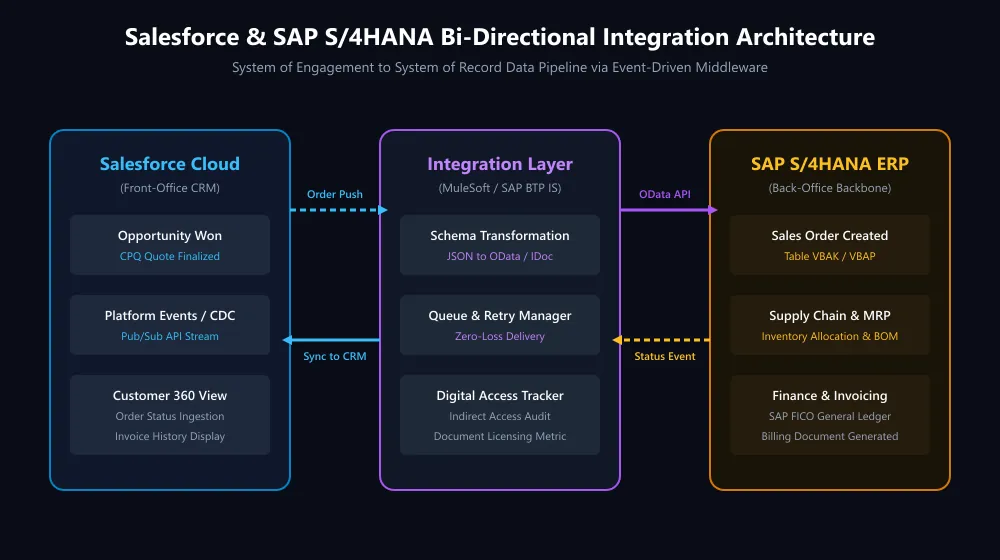
The 4-Step Standard Enterprise Integration Pipeline:
- Trigger & Outbound Event (Salesforce): When an Opportunity reaches Closed-Won or an Order is activated in Salesforce, a Change Data Capture (CDC) event or Platform Event publishes a JSON payload to the enterprise event bus (Apache Kafka, AWS EventBridge, or MuleSoft Anypoint).
- Transformation & Schema Mapping (Middleware): The integration middleware validates the payload against business rules, enriches line items with master product codes, and translates hierarchical JSON structures into SAP-compliant OData V4 payloads or BAPI (Business Application Programming Interface) function calls.
-
Transactional Execution & Record Creation (SAP S/4HANA):
SAP ingests the request via the SAP Cloud Connector, executing standard BAPI modules (such as
BAPI_SALESORDER_CREATEFROMDAT2). SAP verifies credit limits, checks material availability (ATP), generates the Sales Document in tablesVBAK/VBAP, and returns the formal SAP Sales Order Number. -
Asynchronous Callback & Status Update (Salesforce):
SAP publishes an event via SAP Event Mesh. The middleware consumes the event and updates the Salesforce
Orderrecord with fulfillment tracking, billing block flags, and invoice numbers, giving sales reps 360-degree visibility without switching systems.
If your business is transitioning from legacy CRM databases to a unified ecosystem, exploring dedicated CRM migration services ensures that historical customer records, custom fields, and relational dependencies transfer without downtime or data corruption.
7. The Hidden Cost Trap: Licensing, Digital Access & 3-Year TCO Analysis
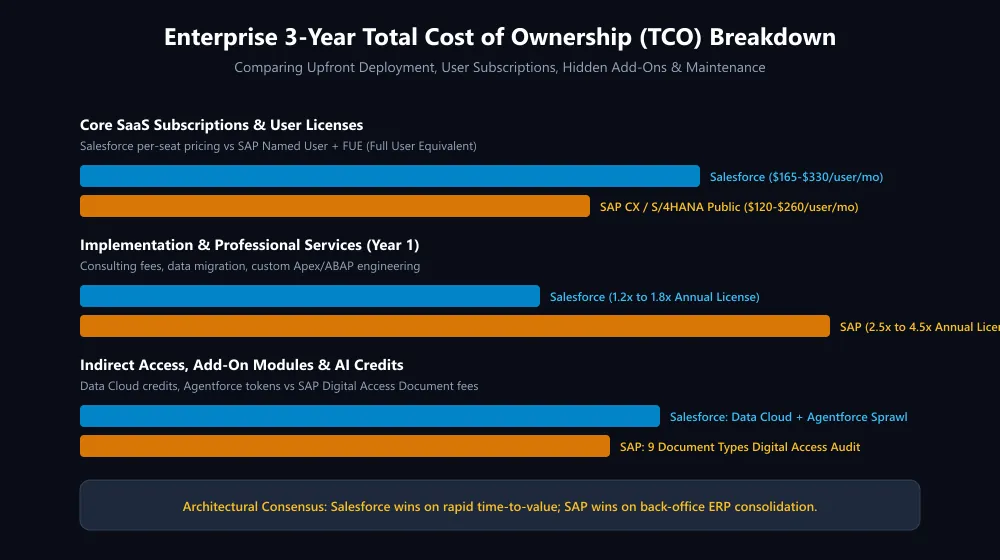
A naive comparison of SAP vs Salesforce often looks only at headline subscription pricing (e.g., $165/user/month for Salesforce Enterprise vs. $140/user/month for SAP CX). However, the true Total Cost of Ownership (TCO) is governed by hidden licensing metrics, implementation multiples, and ongoing maintenance.
The SAP Digital Access (Indirect Licensing) Audit Trap
One of the most consequential licensing risks for enterprises integrating external CRMs with SAP is SAP Digital Access. Under this document-based licensing model, any third-party system (such as Salesforce) that creates or queries core business documents in SAP ERP requires paid licensing across 9 billable document types:
- Sales Document (Line items counted)
- Invoice Document
- Purchase Document
- Service & Maintenance Document
- Manufacturing Document
- Material Document
- Financial Document
- Quality Management Document
- Time Document
If your Salesforce automated workflows generate 500,000 sales orders annually in SAP, you must ensure your SAP agreement includes adequate Digital Access Document tiers; failing to do so can trigger severe indirect access penalties during annual audits.
The Salesforce Add-On Sprawl
While Salesforce avoids indirect document penalties, its licensing structure is susceptible to feature sprawl. Core editions (Enterprise or Unlimited) often require costly auxiliary add-ons:
- Salesforce Data Cloud: Consumption-based credits for data ingestion and profile unification.
- Salesforce Shield: Up to 30% uplift on net license fees for field-level encryption, event monitoring, and audit trails in regulated industries.
- MuleSoft Anypoint Platform: Dedicated core licensing fees required for enterprise middleware.
- Premier Support & Sandboxes: Additional recurring line items for high-performance development sandboxes and guaranteed SLA support.
| Cost Category | Salesforce Deployment (1,000 Users) | SAP S/4HANA + SAP CX (1,000 Users) |
|---|---|---|
| Annual Subscription Licenses | $1.98M – $3.60M (Enterprise / Unlimited) | $1.44M – $2.80M (FUE & Named Users) |
| Initial Implementation Ratio | 1.2x to 1.8x Annual License Value | 2.5x to 4.5x Annual License Value |
| Time-to-Value (Go-Live) | 4 to 8 months (Agile iterative rollouts) | 12 to 24 months (Phased waterfall / hybrid) |
| Variable Consumption Costs | Data Cloud credits, Agentforce conversation units | Digital Access document packs, BTP capacity units |
| Ongoing Internal Administration | 2-4 Certified Salesforce Administrators | 3-6 Dedicated SAP Basis, ABAP & Functional Leads |
8. Strategic Decision Matrix: When to Choose Which Platform
Selecting the right platform requires filtering your decision through company size, business model, IT maturity, and the physical complexity of your products. Use this decision matrix to guide your leadership team:
Choose Salesforce When:
- Your competitive advantage relies on hyper-responsive, personalized customer engagement across digital channels, social media, and customer support.
- You require an intuitive UI that sales teams adopt voluntarily, driving pipeline transparency and fast onboarding.
- Your operational processes change rapidly, demanding declarative ("clicks-not-code") updates without multi-month development cycles.
- You sell digital services, financial products, or software where physical inventory and multi-tier bills of materials do not dictate the sales process.
Choose SAP When:
- You are a heavy manufacturing, industrial, chemical, or global logistics enterprise where the customer order is inseparable from factory floor schedules, supply chain raw materials, and warehouse logistics.
- Your executive leadership enforces a unified ERP core mandate to eliminate disparate databases across international subsidiaries.
- You require deep, real-time variance accounting, multi-currency ledger consolidation, and complex global trade compliance.
- You are already heavily invested in SAP S/4HANA and wish to leverage native pricing condition tables and variant configuration engines.
When to Consider a Custom CRM Alternative:
For high-growth mid-market businesses and specialized enterprises, neither off-the-shelf giant is guaranteed to deliver acceptable ROI. If your operational workflows are unique, paying multimillion-dollar annual licensing fees for bloated feature sets can drain capital. In such scenarios, partnering with experienced CRM development services to engineer a proprietary, custom CRM database provides complete data ownership, tailored API integrations, zero per-user licensing fees, and bespoke AI capabilities tailored exactly to your revenue model.
To evaluate whether a custom database or a commercial platform aligns with your budget, read our detailed architectural guide on how to build a custom CRM.
9. Frequently Asked Questions
What is the primary difference between SAP and Salesforce?
Can an enterprise use both SAP and Salesforce simultaneously?
What is SAP Digital Access and how does it affect Salesforce integration?
How do Salesforce Agentforce and SAP Joule compare in enterprise AI?
Which platform offers lower 3-year Total Cost of Ownership (TCO)?
How do Salesforce and SAP differ in how they store customer information?

Written by Rehan Saeed
Founder & Lead CRM Architect
Rehan Saeed is an enterprise software engineer and lead CRM architect with over 15 years of experience designing high-scale CRM platforms, ERP integration middleware, and zero-downtime database migration architectures for mid-market and Fortune 500 enterprises.
Architecting an Enterprise CRM or SAP Integration?
Our team of senior CRM architects and integration engineers helps mid-market and enterprise organizations design resilient, bi-directional data pipelines, evaluate CRM ROI, and build custom database solutions tailored to exact operational workflows.