Why Insurance Agencies Need CRM Software: The 2026 Guide
Why do insurance agencies need CRM software? Because an insurance agency does not sell one-time transactional products—it manages living, recurring contracts subject to premium shifts, multi-carrier data downloads, carrier rate hikes, and regulatory compliance. Generic CRMs and manual spreadsheets leak up to 18% of agency book equity each year. Dedicated insurance CRM software unifies (1) omnichannel comparative rater intake, (2) automated 90-60-30 day expiration defense engines, (3) multi-line coverage gap discovery, (4) ACORD/IVANS carrier sync, and (5) immutable Errors & Omissions (E&O) audit logging.

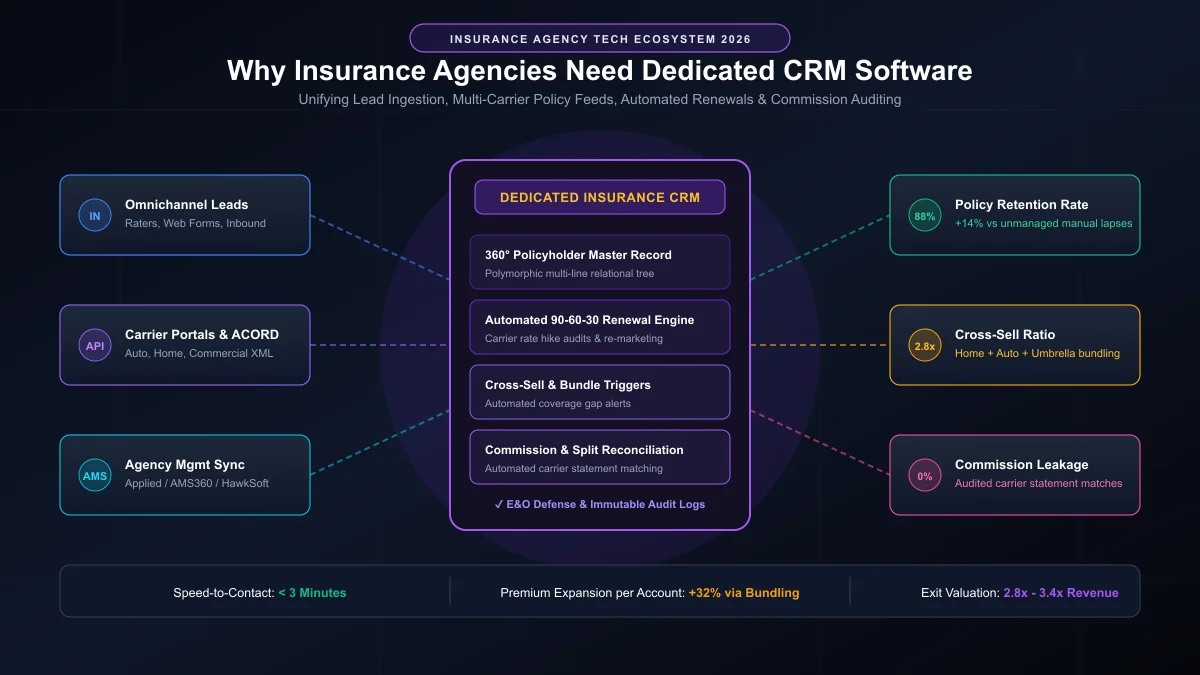
Table of Contents
In the modern insurance landscape, independent agencies, managing general agents (MGAs), and brokerage firms face an unprecedented operational paradox. Consumer expectations for instantaneous digital quotes, transparent coverage options, and multi-channel communication are at an all-time high. Yet behind the scenes, an alarming number of insurance producers remain trapped inside an administrative quagmire: tab-hopping across dozens of carrier portals, wrestling with disconnected spreadsheets, and relying on antiquated back-office software originally coded during the desktop era.
This operational fragmentation is not merely an inconvenience—it represents direct capital erosion. Research conducted by Bain & Company reveals that a mere 5% enhancement in customer retention can accelerate overall insurance agency profitability by 25% to 95%. Conversely, when an agency suffers from silent customer churn—losing clients to sudden rate increases or failing to follow up 60 days before expiration—the cost of replacing that lost revenue through cold customer acquisition is five to seven times higher.
This reality answers the pressing question confronting every modern agency principal: why insurance agencies need CRM software designed specifically for the insurance lifecycle. At CRM Development Services, our architectural evaluations show that in this digital era, agencies must dismantle the limitations of generic sales tools, examine the engineering foundations of high-performing insurance agency CRMs, and deploy specialized automation to protect their most valuable asset: its book of business.
1. The Insurance Agency Dilemma: The Crisis of Administrative Friction
To understand the necessity of specialized insurance CRM software, one must first audit the daily operational friction experienced by insurance agents. An insurance producer does not sell standardized physical inventory. Instead, they broker complex risk transfer agreements governed by rigorous underwriting guidelines, state insurance department regulations, and fluctuating carrier appetites.
Consider the journey of a single commercial property & casualty (P&C) inquiry in a non-automated agency:
- Scattered Ingestion: The inquiry arrives through a web rater or email form, sitting idle in an inbox for hours while producers finish client calls.
- Duplicate Keying: To deliver three competing quotes, the producer manually re-types identical commercial exposure data, payroll numbers, and vehicle identification numbers (VINs) across three separate carrier extranets.
- Disjointed Follow-Up: Quotes are dispatched via individual emails. If the prospect fails to respond, there is no automated trigger to follow up at 48, 96, or 144 hours.
- Zero Lifecycle Visibility: Once bound, the policy is archived inside an accounting-focused legacy system. The agency remains completely blind to upcoming renewals until the carrier issues an automatic renewal bill—frequently containing a 15% rate hike that prompts the policyholder to shop elsewhere.
According to the National Association of Insurance Commissioners (NAIC), agency operational inefficiencies and improper record management are among the leading triggers for consumer friction and regulatory scrutiny. For growing agencies seeking sustainable scale, this manual status quo is completely unsustainable.
Industry data from the Insurance Information Institute (III) reveals that the retention rate for a client holding a single policy (monoline) averages just 67%. However, when an agency bundles auto, homeowners, and an umbrella liability policy into a multi-line relationship, retention skyrockets to over 91%. Without an intelligent CRM identifying coverage voids, agencies leave hundreds of thousands of dollars in lifetime value on the table.
2. Why Generic CRMs & Spreadsheets Fail the Insurance Model
When agency leaders recognize the need for digital modernization, many make the costly mistake of adopting off-the-shelf B2B sales CRMs such as generic Salesforce Sales Cloud, HubSpot, or Zoho. While these platforms excel at tracking linear B2B software sales deals, their underlying database schema fundamentally clashes with the data reality of insurance.
The Relational Data Entity Mismatch
In standard sales software, data is modeled around a simple, three-tier entity hierarchy: Lead → Contact → Opportunity/Deal. A deal moves through pipeline stages until it reaches "Closed Won," after which the sales workflow terminates.
Insurance relationships, however, are deeply polymorphic and non-linear. A single client record (an individual or commercial enterprise) must maintain multiple active policy relationships across different carriers, policy types, effective terms, and coverage schedules:
- Hierarchical Policy Association: A single commercial account may simultaneously hold Commercial General Liability (Carrier A), Commercial Auto with 14 scheduled VINs (Carrier B), Workers’ Compensation with monthly payroll audits (Carrier C), and Cyber Risk (Carrier D).
- Continuous Cyclical Expirations: Unlike a software contract that is sold once, each insurance policy represents a continuous, recursive 6-month or 12-month lifecycle demanding policy endorsements, mid-term rate adjustments, and structured renewal remarketing.
- Standardized Industry Protocols: Generic CRMs possess zero native comprehension of insurance-standard data formats like ACORD forms (ACORD 25 for Certificates of Insurance, ACORD 125 for Commercial Applications) or IVANS AL3 carrier download feeds.
When agencies attempt to contort a generic CRM to handle these intricacies, they run into massive technical debt. Custom development fees spiral, custom fields multiply uncontrollably, and producers eventually abandon the software because it fails to reduce their administrative overhead. For deeper context on evaluating CRM foundations, review our analysis on why is having a CRM important to a business.
3. The 6 Core Operational Pillars Solved by Dedicated Insurance CRM Software
A purpose-built insurance CRM solves these systemic issues by anchoring its entire feature architecture to the actual workflows of producers and account managers. Below are the six fundamental capabilities that explain why high-growth agencies view specialized CRM software as their non-negotiable growth engine.
1. Omnichannel Lead Capture & Comparative Rater Velocity
In the insurance sector, speed-to-contact is the single greatest predictor of conversion. Inbound prospects seeking personal auto or commercial general liability quotes are almost always shopping multiple agencies simultaneously. Studies from McKinsey & Company emphasize that insurance distributors that respond to digital inquiries within five minutes are up to seven times more likely to bind the policy than those responding after an hour.
An insurance CRM integrates directly with agency website quote forms, social lead ads, aggregator raters (such as EZLynx, Turborater, or PL Rating), and third-party lead vendors via webhooks and RESTful APIs. When a prospect submits an inquiry:
- The CRM parses the lead payload in sub-second time, validating contact details and scrubbing duplicates against existing policyholder records.
- Automated round-robin or territory-based distribution routes the lead to the licensed producer best matched for the line of authority.
- An automated, hyper-personalized SMS and email acknowledgment is dispatched immediately, confirming receipt and presenting immediate scheduling links.
To explore how modern APIs drive this connectivity, consult our guide on 5 essential APIs your CRM must integrate with.
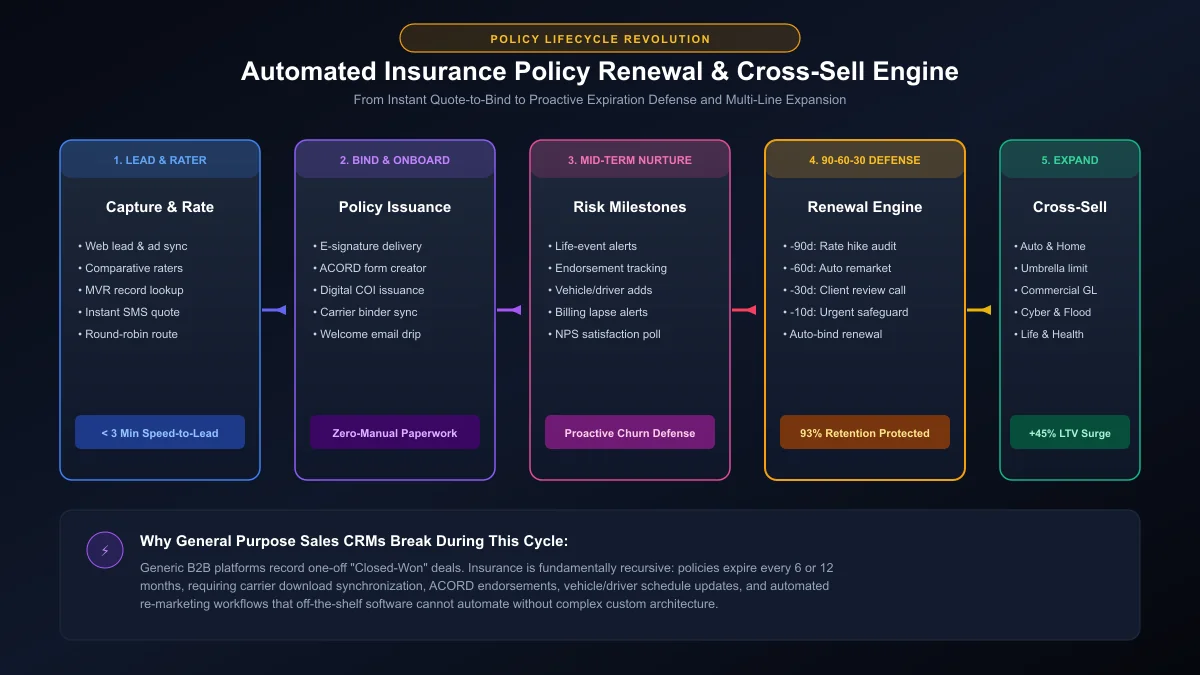
2. The Automated 90-60-30 Day Expiration & Renewal Engine
The lifeblood of an independent insurance agency is its recurring renewal commission stream. Yet all too often, policy expirations slip through the cracks until an unnotified insured receives an unexpected premium spike in their postal mail.
Dedicated insurance CRM software automates the entire renewal defense protocol on a strict milestone timeline:
- Day -90 (Pre-Renewal Audit): The CRM inspects the upcoming policy expiration, automatically queries the carrier's renewal feed, and compares the new premium against the expiring term.
- Day -60 (Proactive Remarketing Trigger): If the renewal premium indicates a rate increase exceeding a preconfigured threshold (e.g., >10%), the CRM automatically flags the account for re-shopping. A task is assigned to the service representative to run comparative rates across secondary carrier partners before the insured begins looking elsewhere.
- Day -30 (Client Review Outreach): The system triggers an automated, branded annual coverage review email and text message to the policyholder, inquiring about major life events (new drivers, home additions, commercial equipment purchases) that necessitate coverage adjustments.
- Day -10 (Urgent Expiration Safeguard): If no renewal binding confirmation has been logged, the system escalates the account to producer priority queues to avoid catastrophic policy lapses.
3. Dynamic Cross-Selling & Coverage Gap Detection
Most insurance agencies sit on an untapped goldmine within their existing book of business. Thousands of clients purchase personal auto insurance but maintain their homeowners or renters policy with a direct writer, or operate a small business without professional liability or commercial umbrella protection.
An intelligent insurance CRM actively scans the agency database for coverage gaps. It identifies accounts matching high-propensity cross-sell profiles:
- Clients with a homeowners policy but no flood or umbrella rider.
- Commercial accounts with general liability but no cyber liability or commercial auto coverage.
- Personal lines policyholders who own businesses or rental properties requiring commercial schedules.
Instead of relying on producers to remember to pitch additional lines during random calls, the CRM schedules segmented, educational nurture campaigns that demonstrate the real financial risks of under-insurance, generating warm cross-sell appointments directly onto producers’ calendars.
4. Carrier Data Synchronization (ACORD & IVANS Protocols)
Insurance producers spend an inordinate percentage of their week logging into carrier extranets (Travelers, Liberty Mutual, Progressive, Hartford, Chubb) to download declaration pages, verify billing statuses, or check cancellation notices.
By leveraging industry-standard ACORD XML/AL3 data exchange standards and IVANS carrier download services, an agency CRM automatically pulls daily policy downloads. When a carrier issues an endorsement, adjusts an annual premium, or generates an intent-to-cancel notice due to non-payment, the CRM automatically matches the data to the appropriate client record, logs the transaction, and alerts the account manager instantly. Explore how we engineer tailored carrier bridges via our CRM integrations development services.
5. Producer Commission Reconciliation & Split Tracking
Commission reconciliation is notoriously one of the most painful back-office bottlenecks in independent insurance agencies. Agencies receive dozens of monthly carrier commission statements—often in incompatible Excel or CSV formats—featuring thousands of line items covering new business, renewal policies, cancellations, chargebacks, and broker-of-record changes.
Dedicated insurance CRM software features automated commission parsing modules:
- In-system ingestion matches carrier commission payouts against expected policy commission rates to catch carrier underpayments.
- Automated calculation of complex producer split agreements (e.g., 50% on new business, 30% on renewal, split across lead generators and writing producers).
- Instant generation of monthly producer statement summaries, eliminating dozens of hours of manual bookkeeping.
6. Errors & Omissions (E&O) Defense & Immutable Audit Trails
In the insurance industry, an undocumented conversation is a catastrophic liability. If a client declines flood insurance or cyber coverage, experiences a total loss, and subsequently files an Errors and Omissions (E&O) lawsuit claiming the agent never offered the protection, the agency must produce concrete, timestamped proof.
An insurance CRM provides absolute legal defense by acting as an immutable record of engagement:
- Every incoming and outgoing phone call recording, SMS interaction, email exchange, and e-signature delivery is automatically linked to the client's file.
- Coverage declination waivers, signed certificates of insurance (COIs), and quote comparison sheets are indexed with unalterable audit logs.
- Agency principals can immediately inspect the complete lifecycle documentation for any policy in seconds, significantly lowering agency E&O insurance premiums.
4. Insurance CRM vs. Agency Management Systems (AMS): Understanding the Synergy
One of the most frequent questions raised by agency executives is: "We already pay for an Agency Management System (AMS) like Applied Epic, Vertafore AMS360, or HawkSoft. Why do we also need an Insurance CRM?"
The answer lies in understanding the distinct architectural purposes of the two software categories:
| Dimension | Legacy Agency Management System (AMS) | Modern Insurance CRM |
|---|---|---|
| Core Strategic Function | Back-office policy ledger, carrier accounting, trust accounting, and regulatory record keeping. | Front-office revenue engine, sales pipeline velocity, customer experience, and retention automation. |
| User Experience | Dense, transaction-heavy forms, legacy desktop interfaces, complex data entry paths. | Modern, mobile-responsive, visual Kanban pipelines, automated communication sequences. |
| Lead & Pipeline Tracking | Extremely weak or non-existent; incapable of automated SMS drips or fast lead routing. | Sub-second ingestion, automated multi-channel follow-ups, comparative rater bridge. |
| Customer Communication | Manual, one-off email templates; no automated behavioral drip triggers. | Omnichannel SMS, WhatsApp, VoIP telephony sync, dynamic email nurture sequences. |
| Renewal Engagement | Generates static reports of expiring policies requiring manual staff review. | Proactive 90-60-30 day automated customer re-engagement and remarketing workflows. |
An AMS is a system of record; an Insurance CRM is a system of engagement and growth. Forward-thinking agencies do not choose between them—they integrate them. By connecting a modern insurance CRM to their core AMS, agencies empower producers with modern sales tools while maintaining rock-solid financial accounting in their back office. To evaluate complete feature architectures, consult our definitive must-have CRM features list.
5. Generic Sales CRM vs. Dedicated Insurance CRM: Architectural Comparison
To illustrate the technical distinctions in data handling and day-to-day operations, the matrix below highlights how generic platforms break down when subjected to insurance workflows.
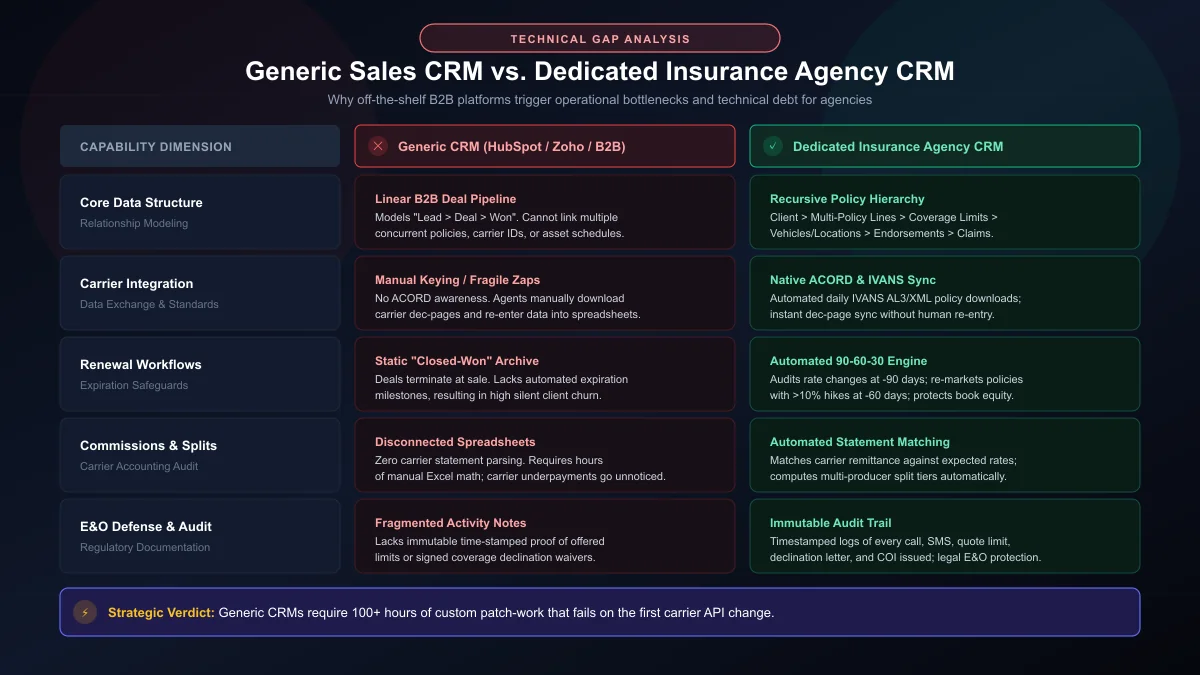
As demonstrated in the comparison matrix, trying to force a generic platform to manage ACORD certificate generation, commercial vehicle schedules, or carrier commission statement reconciliations requires hundreds of hours of custom scripting and brittle third-party middleware. When a carrier modifies its payload structure, those generic workarounds shatter. A specialized solution, customized to insurance standards through professional CRM customization services or specialized financial services CRM development, eliminates this risk permanently.
6. The Quantitative ROI: How CRM Software Transforms Agency Economics
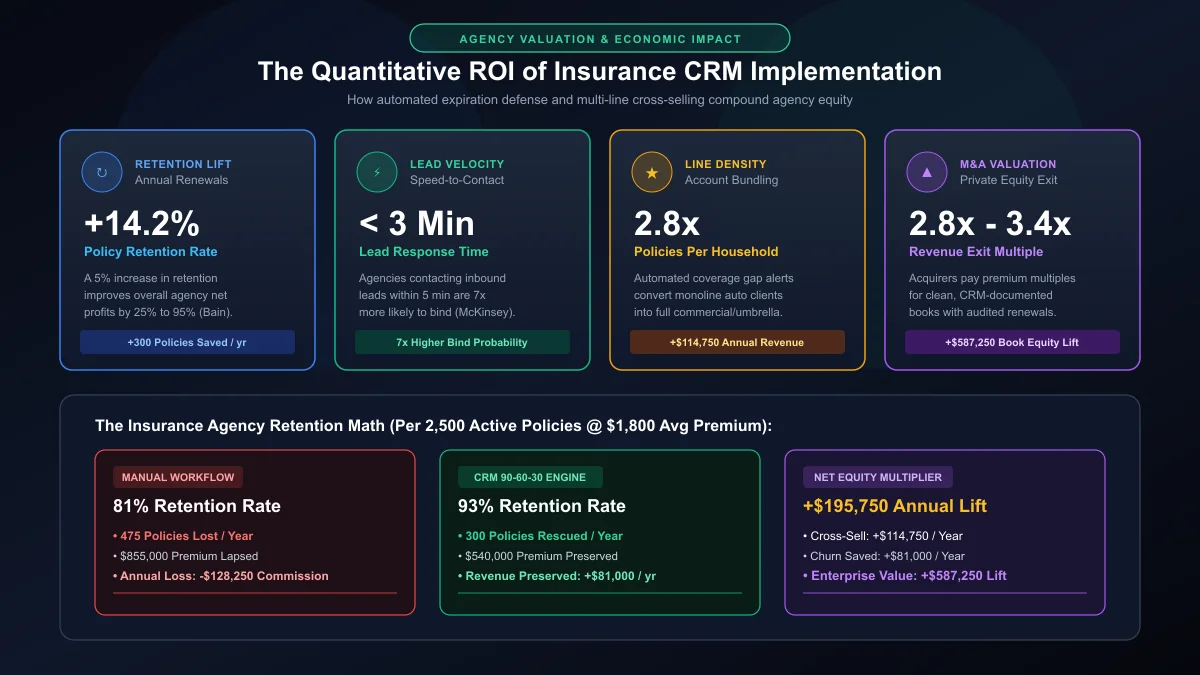
Investing in modern insurance CRM software is not an overhead expense; it is the most lucrative operational investment an agency principal can execute. Below is the quantitative mathematical proof illustrating the economic transformation.
The Retention Multiplier on Agency Net Worth
Let us model a standard mid-sized independent agency holding 2,500 active policies in-force (PIF) with an average annual premium of $1,800 and an average commission rate of 15%:
- Total Agency Book Premium: 2,500 policies × $1,800 = $4,500,000
- Annual Gross Commission Revenue: $4,500,000 × 15% = $675,000
Now examine the compounding financial divergence over three years between an agency with manual workflows versus one operating an automated insurance CRM:
| Metric | Manual Agency (81% Retention) | CRM-Automated Agency (93% Retention) | Net Annual Difference |
|---|---|---|---|
| Policies Lost Annually to Lapses | 475 policies | 175 policies | 300 policies saved |
| Annual Commission Lost to Churn | $128,250 | $47,250 | +$81,000 preserved |
| Cross-Sell Policies Per Account | 1.25 policies | 2.10 policies | +68% premium density |
| Additional Cross-Sell Revenue | $0 (Stagnant) | $114,750 | +$114,750 new revenue |
| Total Annual Revenue Lift | Baseline ($675,000) | $870,750 | +$195,750 / year |
| Agency Exit Valuation (At 3.0x Revenue) | $2,025,000 | $2,612,250 | +$587,250 Book Equity |
By capturing an additional $195,750 in recurring annual revenue through renewal defense and automated multi-line cross-selling, the agency creates over half a million dollars in new enterprise equity. For agencies preparing for generational succession or private equity acquisition, a modern CRM system with clean, documented data is the single most scrutinized factor in achieving premium acquisition multiples.
7. Step-by-Step Implementation Strategy for Growing Agencies
Transitioning to a dedicated insurance CRM requires strategic discipline. Follow this four-stage implementation roadmap to ensure seamless user adoption and immediate ROI without interrupting daily agency operations.
Phase 1: Data Cleansing & Book Migration
Before ingesting legacy data, conduct a thorough database audit. De-duplicate duplicate contact records, correct expired policy statuses, and standardize naming conventions for commercial entities. If migrating off legacy software or disparate spreadsheets, consult our specialized CRM migration services to preserve complete historical notes, policy declarations, and transaction histories with zero operational downtime.
Phase 2: Carrier & Rater Pipeline Integration
Connect your comparative raters (EZLynx, Turborater, PL Rating) and establish IVANS AL3 download feeds. Configure automated lead assignment rules based on state licensing, line of business (personal auto, homeowners, life, commercial casualty), and producer capacity.
Phase 3: Automated Milestone & Drip Configuration
Build your core trigger workflows:
- The 90-60-30 day policy expiration sequence.
- New policyholder onboarding sequences (delivering digital ID cards, policy review appointments, and welcome surveys).
- Automated certificate of insurance (COI) request handling.
- Cross-sell trigger tags (e.g., auto-tagging new homeowners policyholders for umbrella review within 60 days).
Phase 4: Producer Training & Adoption Enforcement
Software is only as effective as the producers using it. Implement visual pipelines that make producers' daily lives simpler rather than more bureaucratic. Eliminate redundant tasks: when a producer realizes that the CRM automates their follow-up emails, schedules their appointments, and computes their commission statements, adoption reaches 100%. For enterprise deployment roadmaps, discover our CRM platform implementation services.
8. Frequently Asked Questions (FAQ)
Why do insurance agencies need specialized CRM software instead of generic CRMs like HubSpot or Salesforce?
What is the difference between an Agency Management System (AMS) and an Insurance CRM?
How does an insurance CRM improve agency client retention?
How does CRM software protect an insurance agency against Errors and Omissions (E&O) claims?
Can an insurance CRM integrate with comparative raters and carrier portals?
9. Summary: Future-Proofing Your Agency’s Book of Business
In an era dominated by direct-to-consumer digital insurtech carriers and escalating consumer expectations, independent insurance agencies cannot survive on manual follow-ups, fragmented carrier portals, and static spreadsheets. The agencies leading the industry in 2026 are those that operate on high-velocity digital rails: capturing leads in seconds, delighting policyholders with proactive service, and rigorously defending their renewals through automated intelligence.
Specialized insurance CRM software is not an optional tech luxury—it is the operational foundation of modern agency profitability, enterprise valuation, and E&O compliance. Partnering with a dedicated engineering team for custom CRM development ensures your agency's workflows, carrier integrations, and client engagement systems scale seamlessly without vendor lock-in.
Ready to Modernize Your Insurance Agency CRM Infrastructure?
Whether you need a custom-engineered insurance CRM platform, bidirectional integration with your AMS and comparative raters, or a zero-downtime migration of your policy records, our senior CRM architects are ready to assist.
About the Author: Rehan Saeed
Rehan Saeed is an enterprise CRM architect with over 12 years of hands-on experience designing bespoke CRM architectures, multi-carrier data synchronization pipelines, and automated policy lifecycle platforms for insurance agencies, MGAs, and financial service organizations across North America and Europe.